


What is Cutover?
Cutover is an AI-powered execution platform that simplifies complexity, streamlines work, and increases visibility across enterprise IT operations. Its scalable, automated runbooks connect teams, technology, and systems to increase efficiency and reduce risk in areas like disaster recovery, incident management, and cloud migration. Trusted by world-leading institutions, Cutover transforms enterprise execution with a centralized, auditable system of action.
Introduction to major incident management
In today’s digital-first world, uptime is everything. When a major incident strikes such as a critical application outage, a cyber attack, or an infrastructure failure every second counts. The speed, coordination, and efficiency with which technology teams can respond may determine your organization's financial performance and reputation.
Despite the high stakes, many organizations still rely on fragmented tools, manual coordination, and reactive processes to manage major incidents. This guide explores the challenges of traditional major incident management (MIM), the role of artificial intelligence (AI) and automation in transforming the response process, and how solutions like Cutover Respond are enabling large enterprises to achieve faster, more coordinated responses and lowering their mean time to resolution (MTTR) .
Chapter 1: Why are existing major incident management solutions insufficient?
Most organizations today are still using incident management tooling that does not meet their needs of speed and accuracy when dealing with the stress of a major incident. Whether it’s performance issues, fragmented tooling that requires users to constantly switch between solutions, or slow mobilization due to poor visibility and communication, insufficient tooling poses a number of risks.
The risks of poor major incident management
Inadequate major incident management and tooling is characterized by:
- Slow mobilization: It takes too long to find and reach the right people and Major Incident Managers (MIMs) waste time coordinating resources instead of managing the incident.
- Poor visibility and tracking: MIMs lose track of who’s doing what when using chat channels to manage the event under pressure, so steps get missed as the response becomes chaotic.
- Poor stakeholder visibility and comms: MIMs get bombarded with status requests when they’re trying to manage the incident. Everyone feels they have to stop when a stakeholder makes a status request, while leaders and other teams are out of the loop and frustrated.
- Manual effort slowing down resolution: Too much time is spent on repetitive tasks that could be automated and it’s hard to spot trends or priorities when things are moving too fast.
- Time-consuming and inaccurate reporting: Post-incident reviews take a long time to write up, the same mistakes are repeated across incidents because lessons learned don’t get shared or actioned, and every incident feels like starting from scratch.
These issues can lead to the following impacts:
- Extended downtime: Every minute of downtime costs money - often thousands or even millions of dollars per hour depending on the industry.
- Lost productivity and financial losses: Resulting from essential systems being down or inaccessible.
- Brand damage: Customers today expect reliability and outages erode trust.
- Regulatory impact: In highly regulated industries, delays in incident response can result in compliance issues and legal consequences.
What functionality should major incident management software include?
To address the challenges above, you need to choose an incident management solution that offers:
- Centralized command and control: One of the biggest challenges that Major Incident Managers face is having to pivot between different tools during an incident response, costing valuable time and creating greater stress and risk. Having a centralized solution that unifies these tools, for example by integrating with your IT service management (ITSM) platform, avoids the need to constantly switch between them and will make incident response faster, more efficient, and more effective.
- Another challenge is that communications and the actions that need to be taken are often only captured in chat functions. Using a centralized platform to turn these chats into tasks that live in one place with unified communications will create greater visibility and collaboration during and after the event.
- Real-time visibility and tracking: Keeping track of what’s happening during the chaos of an incident can be challenging without the right visibility functionality in your MIM solutions. Choose a platform that provides a live view of both upcoming and completed activities during the incident, so that Major Incident Managers, responders, and stakeholders all have a full understanding of progress. Dashboards and a live activity feed help teams stay aligned and make informed decisions quickly.
- Automated runbooks and workflows: Taking your incident management tasks out of disparate communications such as chat functions and instead having the ability to turn these into task-driven runbook plans is a key maturity step for improving your response times, so look out for solutions that enable this. Although every incident is different and requires a unique response, there are certain actions or workflows that will be helpful across multiple scenarios, for example, the actions taken to kick off a response after an incident occurs. A good MIM tool should support the automation of repetitive workflows and provide customizable playbooks to ensure consistent response across incidents.
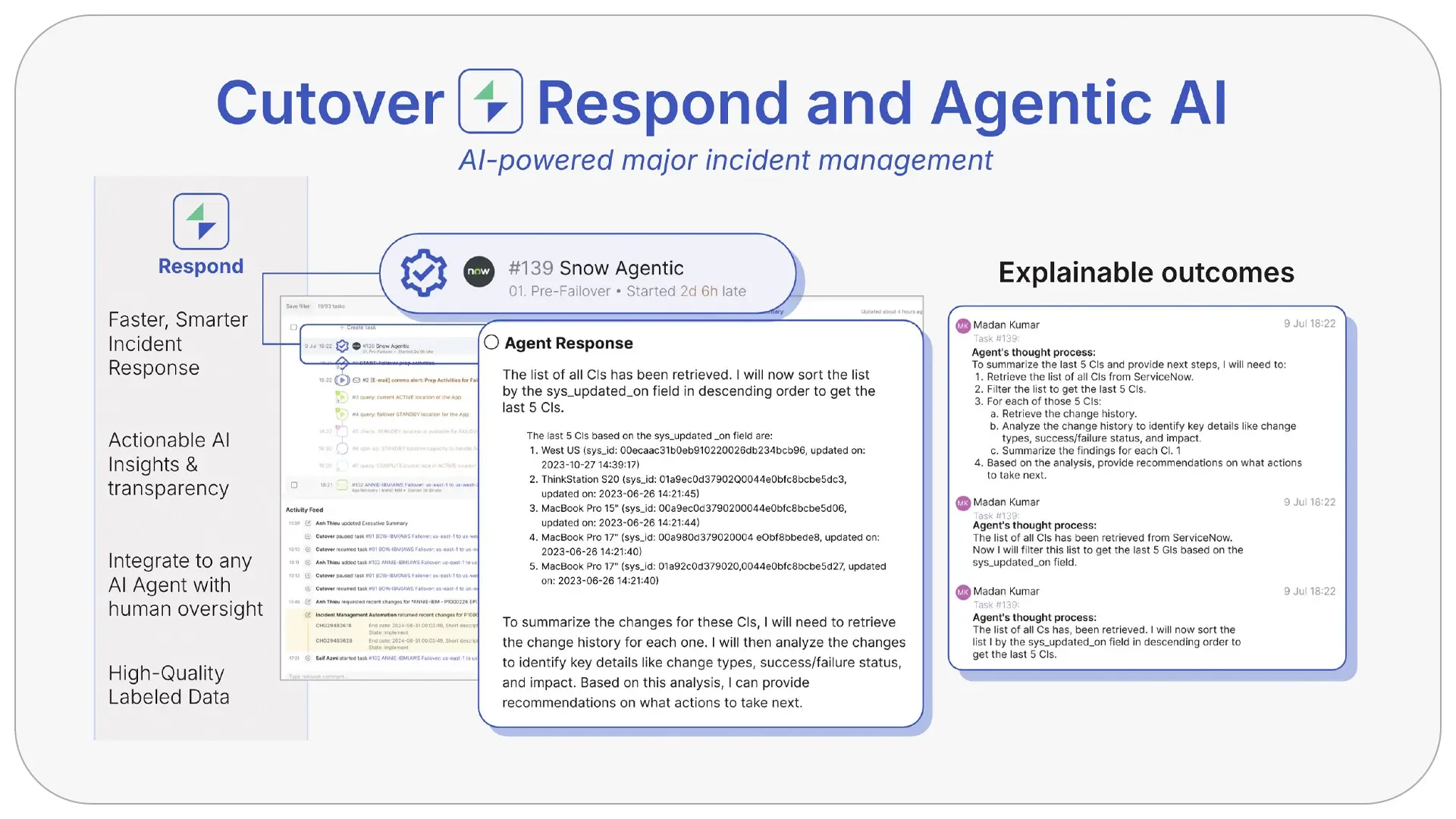
- Agentic AI functionality: Agentic AI transforms incident management by integrating AI and machine learning into a structured, auditable framework. This new paradigm allows human and AI agents to collaborate seamlessly, leveraging existing AI capabilities to perform a wide range of tasks. AI agents can analyze incident data to provide actionable insights, manage routine communications, and automate workflows, freeing up incident managers and resolvers to focus on complex, high-value work. AI agents also address a key challenge in enterprises by moving incident management out of unstructured chat environments into structured runbooks. This process generates high-quality, labeled datasets for every incident, which can be used to train and fine-tune machine learning models, leading to continuous improvement in future responses..
- Post-incident analysis and reporting: Part of continuous improvement is having accurate data from previous responses to draw from. Look for a solution with built-in analytics and reporting to make it easy to identify improvement opportunities and share insights across the organization. These features are also vital for reducing the burden associated with accurate and timely regulatory reporting.
What are the benefits of using the right major incident management tool?
Choosing the right major incident management software is about empowering your teams to respond with speed, precision, and confidence. By prioritizing features like automation, centralized collaboration, and visibility, you’ll be better equipped to reduce downtime, protect your business, and continuously improve in the following ways:
- Reduce Mean Time to Resolution (MTTR)
- Improve communication and collaboration
- Enhance visibility and control
- Increase efficiency and productivity
- Improve post-incident analysis and learning
- Reduce business impact
- Improve customer satisfaction
Chapter 2: How does an AI framework help with managing incidents?
In complex processes such as managing major incidents speed and accuracy are essential. Moreover, the need for human interaction and trust with AI agents is undeniable, especially in regulated industries. There are numerous ways to enable AI with human command and control workflows. We believe that automated runbooks and human-in-the-loop collaboration workflows must be designed in your MIM processes to allow continuous monitoring and intervention plus fostering a "trust but verify" approach. Above all else, leveraging an AI agent framework in your MIM processes you should emphasize transparency and control and align with the following AI principles:
- Explainability: Being able to see the data shared with the AI agent, how it thought about it and what it suggested. This is fundamental to document the data used by the AI agent, its reasoning, and the actions it recommended, providing a clear audit trail.
- Training Tokens: Having an immutable audit log of data that is representative of the incident with the sequence of activities and timings is critical to understand and track the incident response action space. This data is also critical to enable learning and much better agent response in future incidents.
- Safety: All AI agents’ actions and rights need to be expected and controlled. AI agents should only act with the rights and authority to do certain things based on approvals from people. When responding to an incident team members can add their authority to AI agent tasks so it will not act in an uncontrolled way that might cause problems elsewhere, for example, in the infrastructure domain.
This structured approach is far superior to unstructured chat streams, which can be difficult to follow and audit. AI agents can enable a collaborative and intelligent approach for this orchestration, with human oversight at every critical step. This ensures a structured, efficient, and auditable incident resolution process.
By aligning with these principles above, your MIM process becomes the collaborative action space where multiple AI agents can interact under human oversight for major incident management.
Chapter 3: 6 considerations when using AI in the management of major incidents
Advanced AI capabilities should enhance IT operations by integrating intelligent automation with human oversight, focusing on transparency, explainability, and operational safety. But, how should you construct an AI agent resilience framework that emphasizes transparency and control? Here are six (6) considerations and tips.
- Transparent Data Visibility
There should be real-time visualization of data flows to AI models, ensuring clear oversight. Audit logs need to detail every data point accessed and processed, with customizable visibility controls for different user roles and compliance needs.
- Insightful AI Comments
AI-generated explanations need to accompany suggested actions, offering context-aware annotations that highlight factors influencing recommendations. Natural language processing which can translate complex technical insights into accessible terms will foster better collaboration and trust.
- Next Best Actions
Leveraging historical performance data, AI agents could predict optimal steps to enhance operational efficiency. They can adapt task prioritization based on changing conditions and identify potential issues before they impact operations.
- Human Oversight
Users need to maintain control over critical operations through configurable approval workflows. Interactive interfaces must allow for reviewing, editing, and approving AI-suggested actions, with comprehensive logs ensuring accountability and compliance.
- Explainable Outcomes
Your AI platform needs to offer detailed process tracing from input to output, with visual decision trees illustrating AI evaluations. That date should be export-ready into documentation that supports regulatory compliance and auditing requirements.
- Execution Guardrails
Safe operations must be enforced through configurable boundary conditions and real-time monitoring systems that detect anomalies. Automatic fallback mechanisms ensure continuity even in exceptional situations.
These capabilities are designed to enhance IT disaster recovery, cloud migrations, and incident response, enabling organizations to achieve greater efficiency, reliability, and innovation in their operations.
These AI capabilities all reduce the time and effort needed to perform certain tasks during a response where time is of the essence, facilitating a smoother and more successful response.
Chapter 4: What are the best practices for major incident management success?
Because every major incident is different, your response will be slightly different every time, but that doesn’t mean you have to start from scratch with each response. The right tooling provides the opportunity for continuous improvement for faster mobilization, better communication, and speedier resolution.
Here are five best practices to apply to your major incident management process:
- Adopt a task-based approach
Many organizations rely on chat functions to manage and coordinate the tasks that need to be taken during an incident but this method can quickly become chaotic with people having limited visibility, tasks being missed, and ultimately slowing down MTTR. Instead, use AI-powered, automated runbooks to ensure visibility and control, moving tasks out of distributed chat functions and other response tooling and bringing everything into one centralized execution platform.
- Remove siloes via integration
Siloed tooling means reduced visibility, with data scattered across multiple platforms, and causes MIMs and resolvers to need to constantly switch between tools. By integrating your various systems into one comprehensive execution platform, you remove this “swivel-chair effect” and can instead view and manage the event from one place, with the data from your ITSM and monitoring tools, together with tasks and status updates, at your fingertips.
- Centralize communication
Don’t rely on a mix of messaging apps and bridge calls to ensure everyone involved in the incident is on the same page. Avoid delays and missed communications with a unified platform for alerts, updates, and coordination.
- Constantly review and improve
Every incident should lead to refinements in tools and processes. Having the ability to produce an accurate audit log with labelled data that can be analyzed for post-incident review and improvement is essential to this task.
- AI-Agents & Automation
AI agents can represent a significant advancement in major incident management and incident response. The right AI agents are not just about automating tasks; they're about building a trusted, transparent, and explainable incident management ecosystem. By combining the power of AI agents with a robust orchestration and collaboration platform you can enable DevOps and SRE teams to recover systems faster, more efficiently, and with greater confidence. AI agents can automatically identify patterns, predict potential issues, and recommend corrective actions in a controlled manner, significantly reducing mean time to resolution (MTTR).
Chapter 5: Why use Cutover Respond for major incident management?
Cutover Respond offers a solution to streamline and enable automation and AI agents for the entire incident management lifecycle.Through automated workflows, a task-based model, AI agent integration, centralized communication, and real-time visibility, Respond facilitates a faster and more coordinated approach, ultimately reducing MTTR.
Cutover Respond enables you to:
Mobilize your response teams faster
- Instantly pull the right people in without the need to manually chase them. This is especially critical when every minute counts.
- Ensure everyone knows their role from the start, reducing initial confusion and delays.
- Allow the Major Incident Manager to focus on strategy and oversight to resolve the incident, not logistics.
Gain seamless visibility and tracking through a task based model
- Respond gives a clear view of what needs to happen, what is in progress, and what is complete.
- Standardize responses across different types of incidents, so Major Incident Managers are not reinventing the wheel each time there is an incident.
- It’s clear who owns each task, reducing bottlenecks and duplication of effort.
Self-serve communication to avoid team interruptions
- Keep stakeholders informed and engaged without extra effort and interruptions to the response team. Plus, fewer inbound queries from stakeholders asking for updates allows the Major Incident Manager and Resolvers to stay focused on the actual incident.
- Everyone sees the same real-time picture which reduces miscommunication.
Reduce toil and resolve incidents quicker by leveraging AI agents and automation
- Respond with AI can handle repetitive communications such as progress summaries for initial triage and status updates which frees up the MIM to manage the overall incident.
- AI agents can surface trends or anomalies to help prioritize response efforts.
- AI helps Respond orchestrate across teams by suggesting next steps or highlighting blockers.
Automate post-incident review and comprehensive labelled data for learning
- Automate much of the incident documentation which saves hours of manual effort after resolution.
- Respond helps identify patterns across incidents to improve processes and tools.
- Respond makes it easier to refine runbooks and train teams based on real lessons learned.
.webp)
Conclusion: Intelligent automation for major incident management
Major incident management has evolved from a reactive, "firefighting" activity into a strategic discipline demanding precision, automation, and intelligence. The ad-hoc processes and traditional tools of the past are no longer sufficient to handle the scale and speed of modern operations.
Adopting intelligent automation for major incident management helps teams take back control. Benefits of automated incident response includes:
- Faster Response: Automating team mobilization reduces the time it takes to engage the right people, freeing incident managers to direct the response instead of getting bogged down in administrative tasks.
- Seamless Collaboration: Real-time task tracking keeps everyone aligned and accountable, minimizing errors and missed steps, especially when teams are under pressure. This shared visibility also allows stakeholders to self-serve status updates, reducing interruptions and building trust without extra effort from the incident response team.
- Quicker Resolution: By using automation and agentic AI to handle routine tasks like ticket updates, communications, and data collection, teams can focus on high-value work. AI capabilities can even surface actionable insights from log data to help prioritize what matters most for users.
- Continuous Improvement: Automated data capture from every incident provides a complete, accurate record for post-incident reviews. Simplified report generation and auditing not only saves hours but also delivers insights to improve future responses and training.
Cutover Respond is designed to orchestrate, monitor, and continuously improve your major incident management processes. It transforms chaos into coordinated execution through rapid mobilization, seamless visibility, automation, and indelible audit trails.

.webp)