

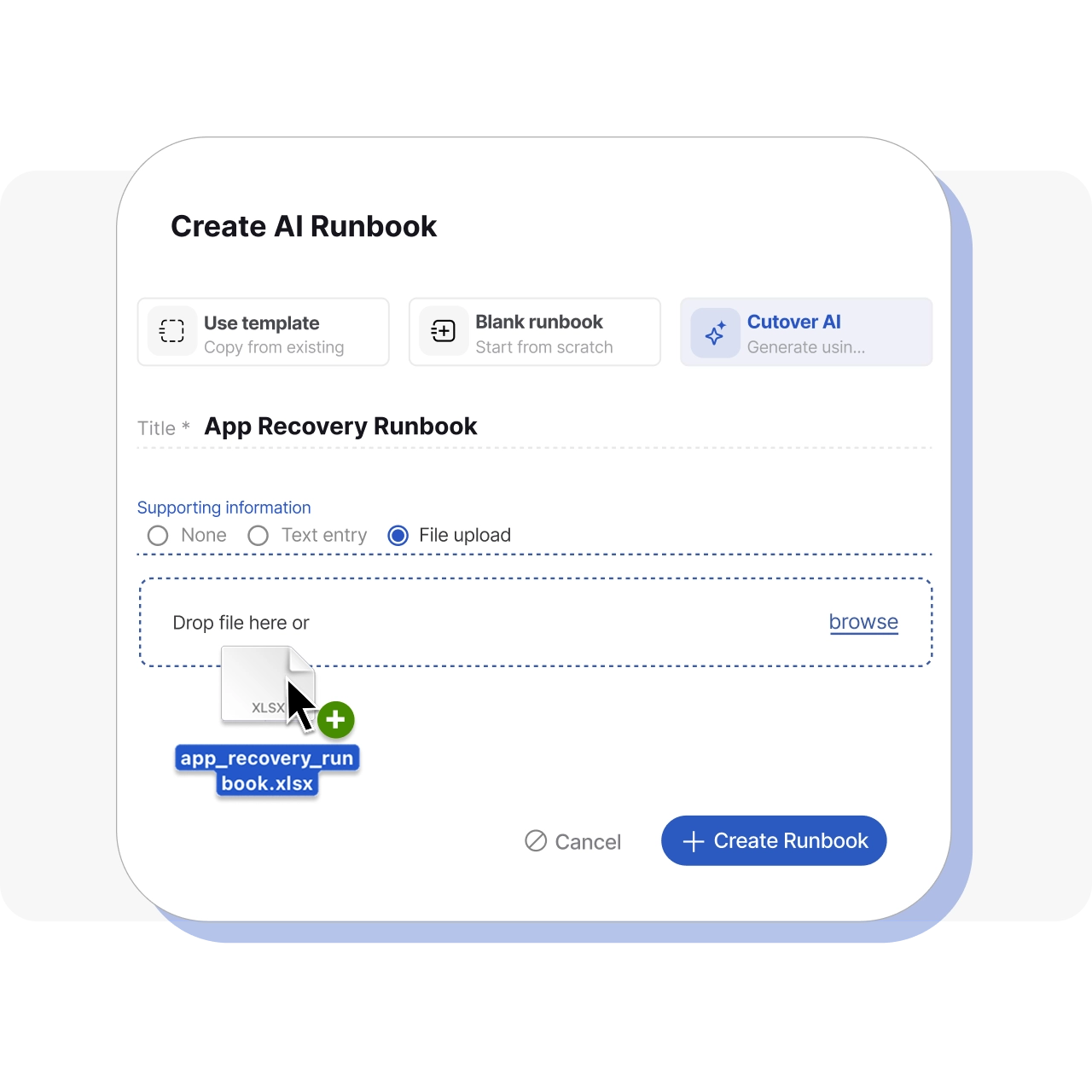
This is a quick demo on using AI and cut over to generate new runbooks. Instead of generating new runbooks completely from scratch, we'll be using retrieval augmented generation or RAG in order to do so. What this means is our first retrieving a dataset and using that to inform the AI on how to construct the new runbook. Right now, we've got two different data sources set up, confluence and runbooks that are already existing on the cut over instance. I'll start by providing a topic that we're going to produce on new runbook on and click generate. As this runs, I'll describe what's going on. Based on this topic, we first start to look at every single confluence page and every single runbook that we have. Whichever runbook or Confluence page has a title with the best semantic match to this topic will be the one that we look at in greater detail. What that means is that we look at the actual meaning, not just the words used in the topic or words used in the titles. Once we found that best match, we start to look at all of the data contained by that source, and that's used to inform the AI on what the process looks like. And that is then used to generate the new runbook. In this case, I already know for a fact that the best semantic match is this confluence page. So this is the one that should be used to generate our new runbook. It takes a little while to run since it uses a few different API calls to make sure that it produces the output correctly. Now that it's finished running, we should see a runbook that's been created. And here we have one based on our prompt. Looking at it in greater detail, we can see that the dependencies have accurately formed, and we have descriptions that talk about the same things that were mentioned in the document on confluence. Another use of rapid retrieval augmented generation in this context is not just copying another source into a runbook, but also modifying the information from an existing data source and transferring that. For example, here we have one runbook, which is on deploying an Android app, and it has fifteen different tasks. Now for our iOS deployment, we'd expect it to look very similar. But but now with this, I previously put in deploy an iOS app, and since this was the most similar, document it could find, it based it off that and made the changes necessary. Now relevant strictly to iOS. Now none of this is perfect, which is why there's also a refined section where based off by giving it a run book ID. And if I copy this auth token, we can now refine what the initial AI created and make it exactly how we want. So what would I actually like in this? I think I'd like to notify stakeholders. And now, if I hit refine, this should be a relatively quick process. And when I go back to that runbook, we should see that there's a new task.
Cutover AI-powered runbooks
Supercharge your response and recovery with advanced enterprise automation and operational resilience. Move beyond simple task automation. Our platform uses generative AI to rapidly create, optimize, and orchestrate runbooks for your recovery, migration, and release processes, driving speed and accountability with a trusted, explainable paradigm for all complex IT operations.


Introducing: Cutover AI Assistant
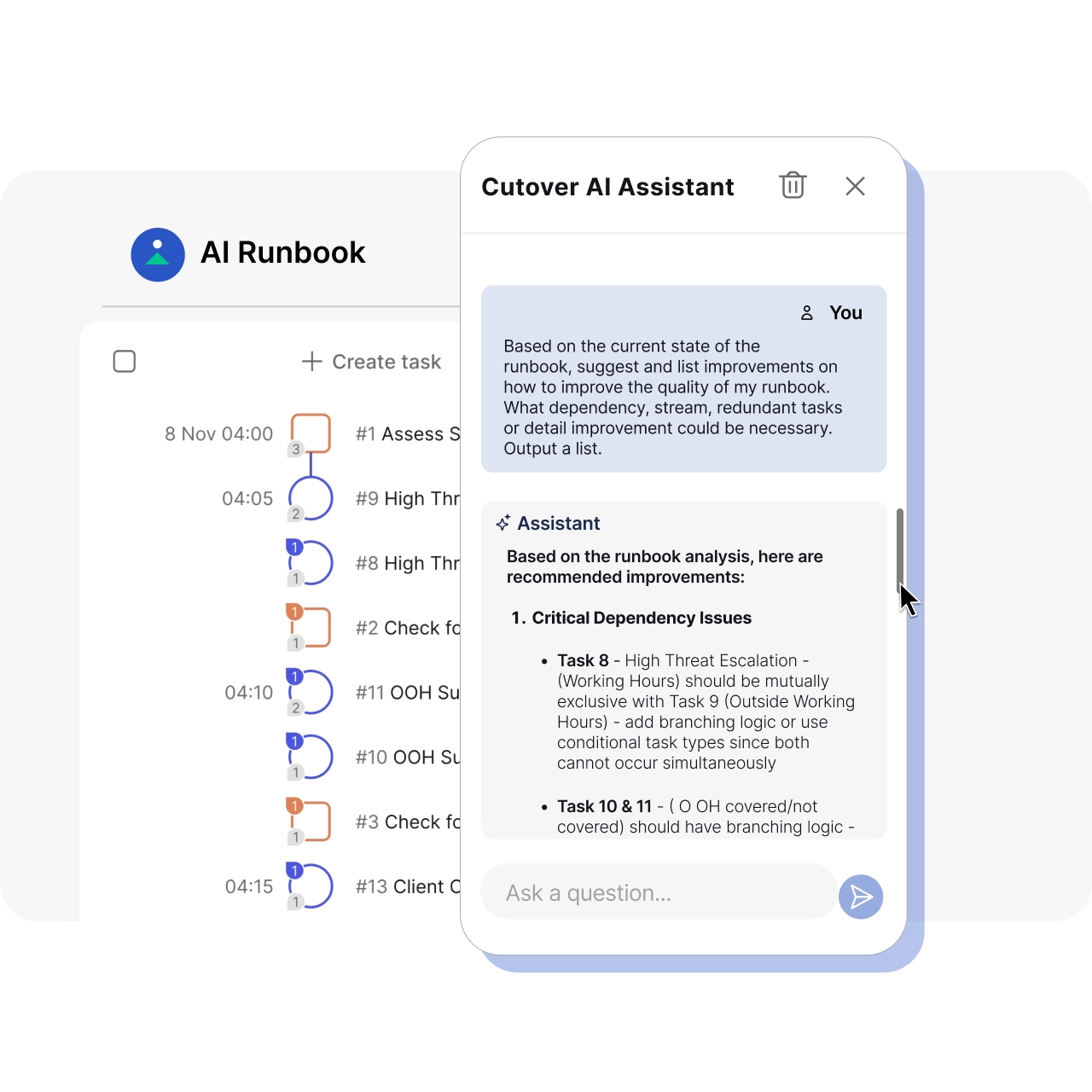
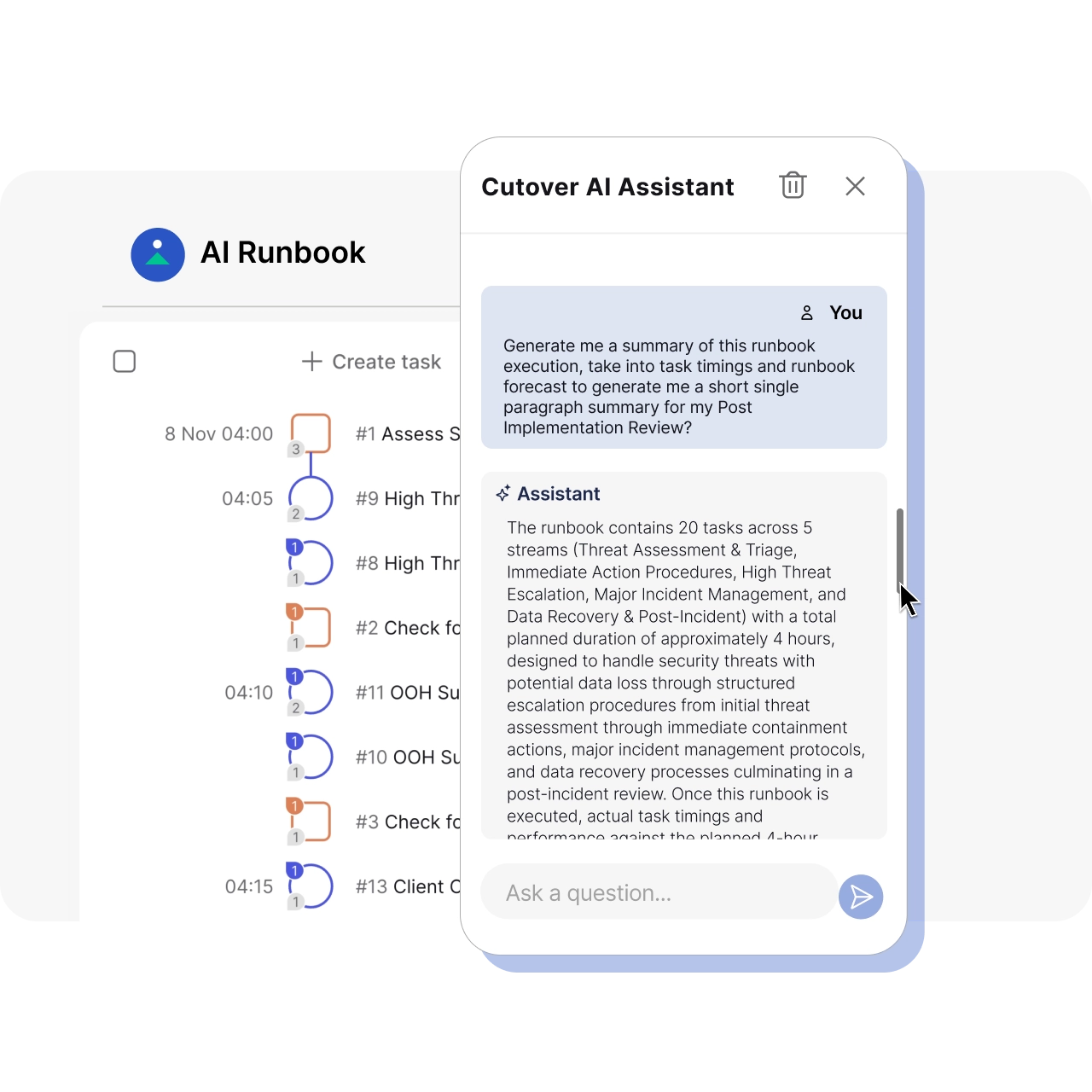
Say hello to the new Cutover AI Assistant. We’ve integrated natural language processing directly into Cutover AI so you can better manage your runbooks with simple conversations. Ask questions to find and fix blockers on the fly, get instant summaries of your runbook outcomes, and make changes fast with natural language commands.
Benefits of Cutover AI features
AI-powered runbook creation
Build runbooks in minutes, not hours with Cutover AI. Instantly generate complete runbooks with tasks, dependencies and descriptions from virtually any static source - including flow charts, spreadsheets, and documents. Combine Cutover AI Create with the Cutover Application Metastore to automatically generate multiple, tailored recovery runbooks at once.
AI-powered runbook improvements
Cutover AI will evaluate runbook effectiveness and suggest intelligent improvements to help you uncover potential bottlenecks or inefficiencies during migrations, recoveries or releases.
AI-powered runbook summaries
Cutover’s AI takes structured runbook data and generates a brief summary of the runbook’s purpose and what it contains, enabling users to understand the goal of a runbook at a glance.
AI Agent access with Model Context Protocol (MCP) Server
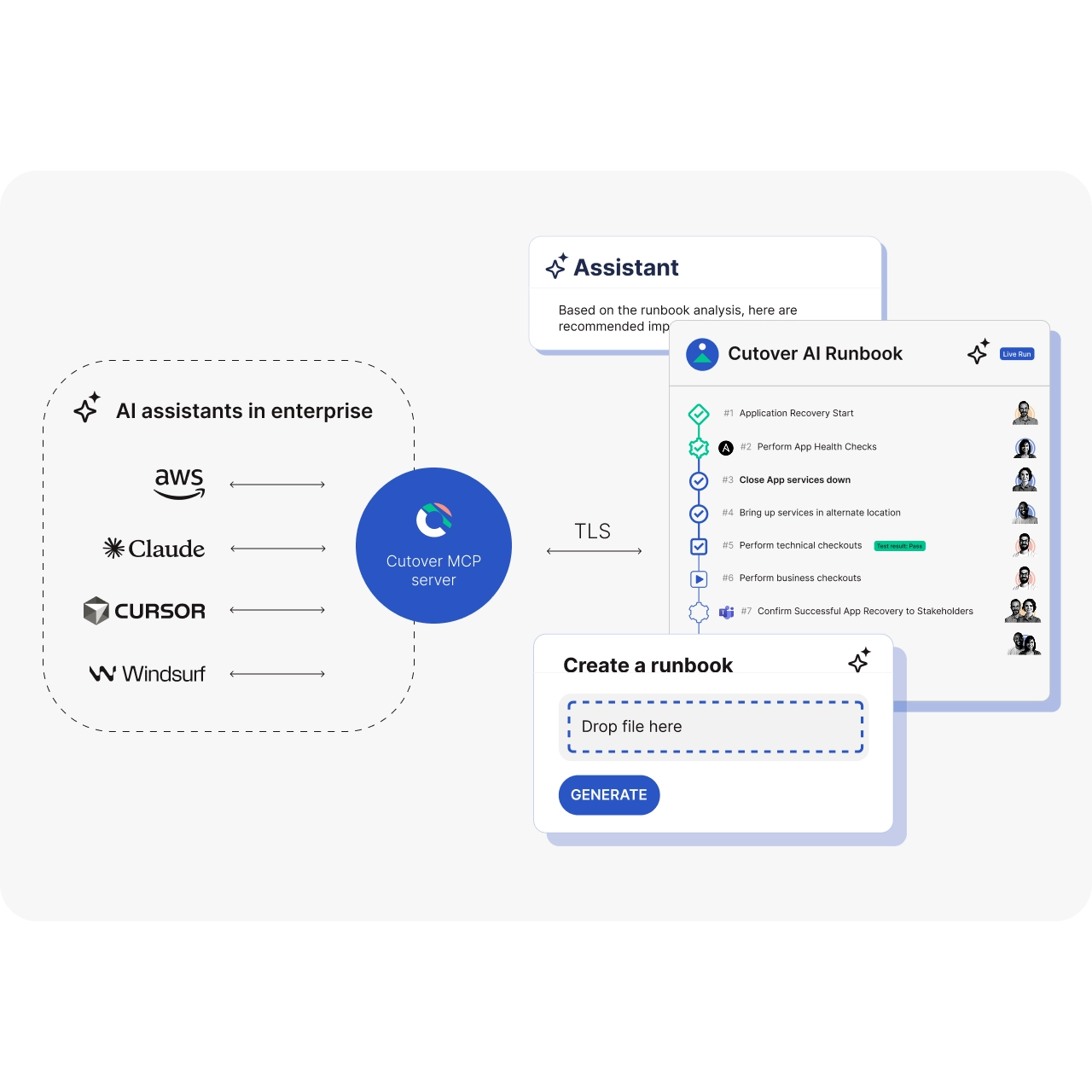
Cutover’s MCP Server standardize how AI LLM models and Agents query your operational and resilience data, enabling them to take direct action on runbooks and tasks using natural language. Get faster insights, seamlessly connect across systems, and reduce manual toil.
Advanced AI capabilities
The Cutover platform combines cutting-edge AI with enterprise-grade orchestration to deliver powerful automated runbook solutions for technical operation teams.

- Real-time data flow visualization showing exactly what information is being sent to AI models
- Clear audit logs detailing every data point accessed and processed by AI components
- Customizable data visibility controls for different user roles and compliance

- AI-generated explanations for suggested actions and decisions, helping teams understand the reasoning
- Context-aware annotations that highlight important factors influencing AI recommendations
- Natural language processing that communicates complex technical insights in clear, accessible terms

- Predictive recommendations for optimizing runbook execution based on historical performance data
- Context-aware task prioritization that adapts to changing conditions and requirements
- Risk-aware decision support that identifies potential issues before they impact operations

- Configurable approval workflows for key decision points in automated processes
- Interactive interfaces for reviewing, editing, and approving AI-suggested actions
- Comprehensive human oversight logs for accountability and compliance purposes

- Detailed process tracing that maps every step from input to output with clear explanations
- Visual decision trees that illustrate how AI systems evaluate options and arrive at conclusions
- Export-ready documentation of AI processing for regulatory compliance and auditing

- Configurable boundary conditions and safety checks that prevent actions outside approved parameters
- Real-time monitoring systems that detect anomalies and trigger appropriate interventions
- Automatic fallback mechanisms that ensure operational continuity even in exceptional situations


