The modern IT landscape demands more than just traditional automation. To increase efficiency and reduce manual errors, enterprises are shifting toward Collaborative Automation - a strategic approach that interconnects people and technology.
This eGuide overviews the role of collaborative automation in technology operations processes like IT disaster recovery and major incident management and how Cutover’s automated runbook solution helps enterprises embrace it.
What are the top trends in automation for technology operations?
Navigating the complexities of the modern IT landscape demands a strategic approach to automation, one that addresses the challenges of chaos caused by siloed teams, embraces the potential of wide-scale automation, utilizes the right tools for the job, and mitigates risk. This chapter delves into the current trends shaping automation for technology operations, shedding light on the challenges and opportunities that lie ahead.
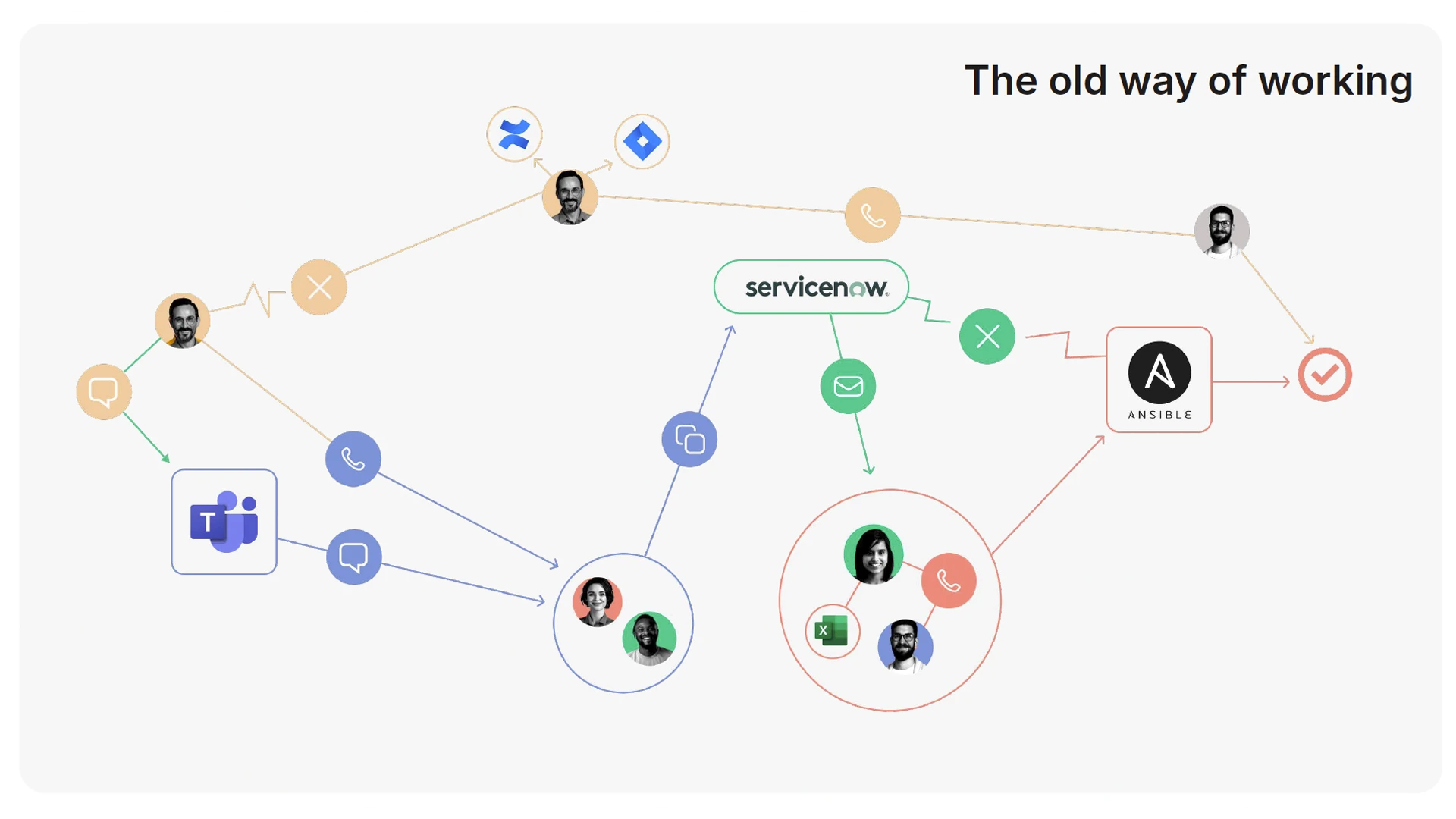
- Chaos caused by siloed teams: A call for integrated automation
Fragmented teams (DevOps, SRE, and Tech Ops) working in isolation often face:
- Duplicate Efforts: Manual tasks are often repeated across teams, driving up labor costs.
- Delivery Inefficiencies: Uncoordinated efforts lead to communication breakdowns and cost overruns.
- Customer Impact: Prolonged incident resolution times result in lost revenue and lower satisfaction
- Automate everything: Embrace the potential of automation
Traditional automation approaches often focus on automating specific tasks or processes, particularly tasks that are repetitive, time consuming, or error-prone. In today’s technology operations, organizations are trying to automate as much as possible. Automation can help to:
- Improve efficiency: Tasks can be completed more quickly and accurately.
- Reduce downtime: Incidents can be resolved more quickly, and systems can be restarted or rebuilt automatically.
- Improve visibility: Automation can provide real-time insights into the health and performance of the network and applications.
- Reduce costs: Labor costs can be reduced and automation can help to prevent costly mistakes.
- Select the right automation tools and solutions
The success of your strategy hinges on using the right tools for specific objectives.
Common Automation Solutions
- AI & Machine Learning: Used for complex decision-making and predictive analytics.
- Robotic Process Automation (RPA): Best for rule-based, repetitive tasks on a desktop.
- IT Automation (e.g., Ansible): Automates infrastructure and configuration management.
- iPaaS: Connects disparate systems for seamless data exchange.
Enterprises should consider factors such as ease of use, scalability, integration capabilities, and vendor support when making their tool selection decisions. They also need to consider how to integrate people into the processes to enable true Collaborative Automation.
- Mitigate the risks of uncontrolled IT automation
A common challenge in automation is the Bathtub Effect, a phenomenon where initial enthusiasm and progress are followed by a sharp increase in complexity and a performance dip.
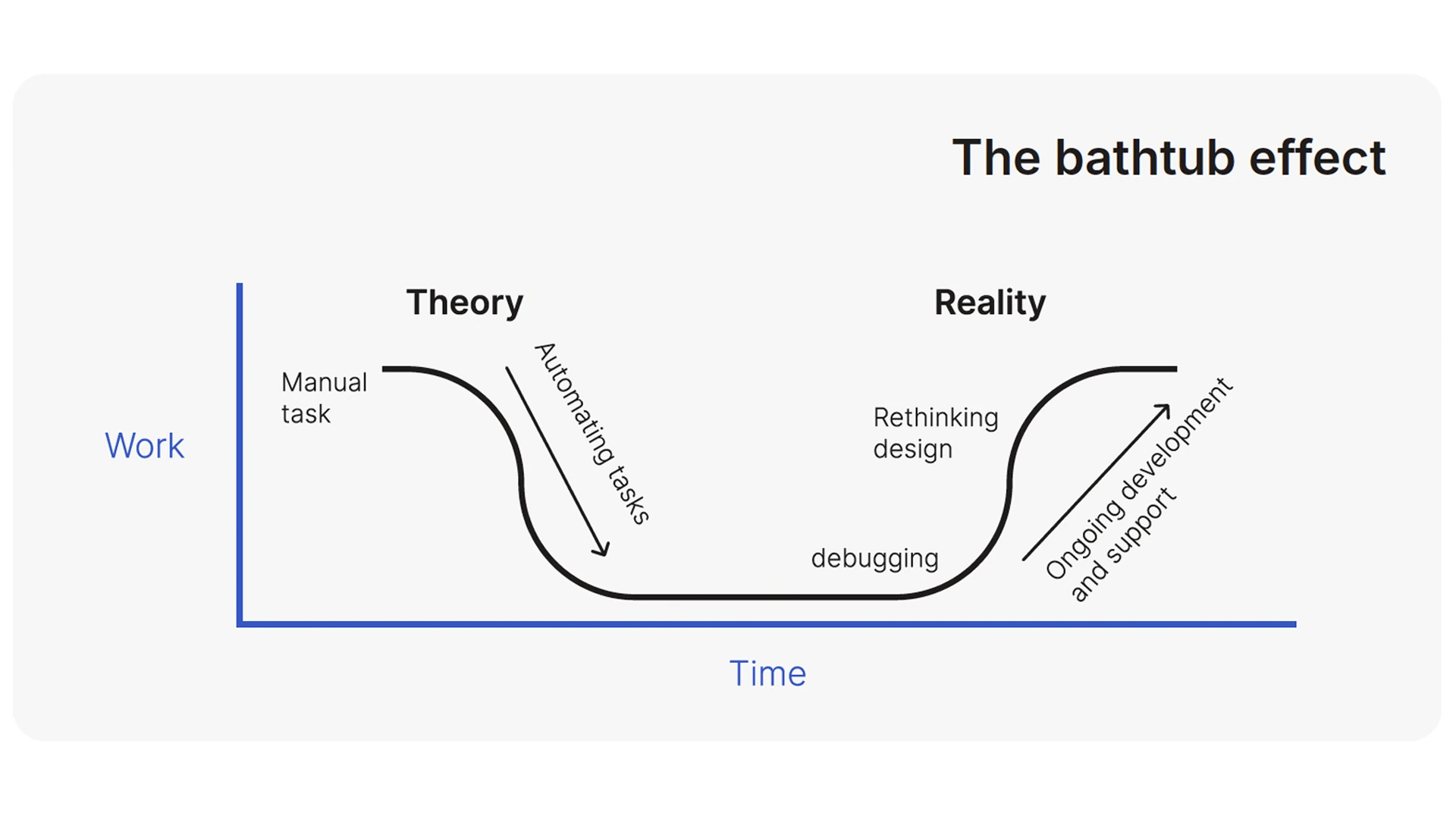
This can happen for a number of reasons, such as:
- Scope creep: The project starts with a clear scope, but as the automation is developed, new requirements or features are added, making the project more complex and time-consuming.
- Technical challenges: Unexpected technical challenges can arise during the development process, which can cause delays and setbacks.
- Lack of resources: The project may not have enough resources, such as manpower or funding, to complete the automation in a timely manner.
- Loss of momentum: As the project progresses, the initial enthusiasm can fade, and the team may lose motivation to see the project through to completion.
To mitigate that bathtub effect, organizations should start small and scale their automation gradually. Rather than try to automate everything at once, begin with simple, repetitive tasks and leverage your teams for judgment and creativity in the processes for a Collaborative Automation approach.
Chapter 2: Collaborative Automation - People and technology are better together
While automation has undoubtedly brought about significant gains in efficiency and productivity, its implementation is often accompanied by misconceptions and concerns. This chapter aims to dispel these myths and shed light on the true essence of Collaborative Automation, a paradigm that emphasizes the harmonious integration of people’s expertise and automation’s technological capabilities.
Myth vs. reality: Dispelling automation misunderstandings
Myth #1: Automation will eliminate jobs
Reality #1: Automation is not about replacing people; it's about augmenting their capabilities. By automating repetitive, mundane tasks, automation frees up people to focus on more strategic, creative, and value-added activities.
Myth #2: Automation is a one-size-fits-all solution
Reality #2: Automation is not a universal solution. Each organization has unique processes and requirements and automation solutions must be tailored to fit the specific needs of the business and its customers.
Myth #3: Automation is easy to implement
Reality #3: Implementing automation requires careful planning, consideration, and change management. It's a continuous process that involves improvement and adaptation over time.
The paradigm shift towards Collaborative Automation
Collaborative Automation is a transformative approach that redefines the relationship between people and technology. It's not a debate about people versus technology, it's about a symbiotic relationship where people and technology work together, leveraging the strengths of each to achieve goals.
Collaborative Automation empowers organizations to achieve:
- Enhanced efficiency and productivity
- Improved decision making and risk management
- Increased innovation and creativity
- Elevated employee engagement and satisfaction
Chapter 3: The limitations of open-source orchestration tools
In the realm of IT automation, open-source orchestration tools offer organizations a cost-effective and customizable solution for automating tasks and workflows. However, these tools fall short in addressing highly complex, large-scale operations such as IT and cyber disaster recovery (DR), cloud migrations, or software release management.
The siloed nature of open-source orchestration tools leads to several challenges:
- Limited visibility and control: Organizations lack a centralized view of automation activities across different domains, hindering effective decision making and coordination.
- Inconsistent user experience: Disparate orchestration tools create inconsistencies in user interfaces and interactions, making it difficult for users to navigate and collaborate effectively.
- Integration complexities: Integrating open-source orchestration tools with other enterprise systems can be complex and time consuming, further siloing automation efforts.
Effectively orchestrating people and technology requires Collaborative Automation
In today's dynamic and interconnected technology operations landscape, Collaborative Automation is not merely an option; it's a necessity. Collaborative Automation empowers organizations to:
- Bridge the gap between people’s expertise and what automation does best
- Enable real-time decision making
- Foster innovation and agility
Visibility and dashboards provide IT operational insight
Visibility is a crucial component of effective technology operations orchestration. Dashboards provide organizations with real-time insights into automation activities, enabling them to: monitor progress and performance, identify and resolve issues, and analyze trends and patterns.
Conclusion: Collaborative Automation offers much more than open-source orchestration tools can provide
Open-source orchestration tools have undoubtedly played a valuable role in automating technology operations but, as noted above, they also have several disadvantages. A Collaborative Automation platform, on the other hand, enables a comprehensive strategy that encompasses people, technology, and visibility.
Chapter 4: Four ways to use Cutover for Collaborative Automation
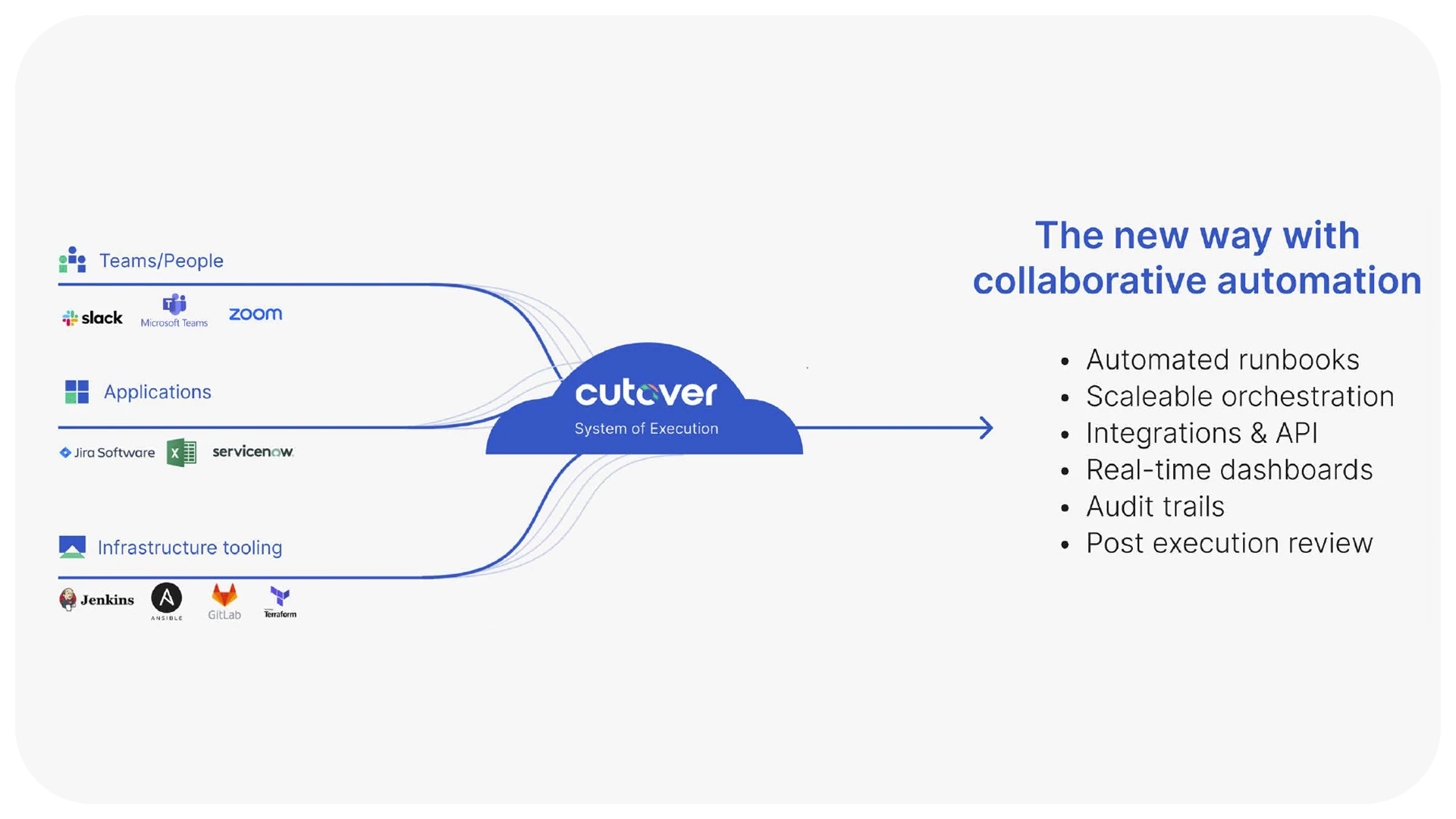
Cutover’s SaaS platform serves as a "System of Execution," with automated runbooks orchestrating the interplay between human expertise and automated runbooks.
- Cyber and IT disaster recovery
Cyber and IT DR is a critical process for organizations, ensuring business continuity in the face of unplanned technology disruptions. Cutover’s Collaborative Automation platform can play a pivotal role in enhancing the effectiveness of recovery efforts:
- Automated Execution: Triggers failover procedures and engages teams instantly.
- Human-in-the-loop: Facilitates collaboration between security analysts and stakeholders for complex recovery decisions.
- Auditability: Generates immutable audit trails for regulatory compliance.
- Cloud migration
Cloud migration projects are often complex and time consuming but Cutover’s Collaborative Automation platform can streamline the process through:
- Orchestration: Provisions infrastructure like VMs and storage automatically.
- Transparency: Provides real-time visibility into upstream and downstream dependencies.
3. Application release management
Application release management is a critical process for ensuring the successful deployment and maintenance of software applications. Cutover’s Collaborative Automation platform can enhance release management practices with:
- Testing & Deployment: Automates software release testing to ensure quality standards.
- Continuous Delivery: Supports CI/CD practices for rapid, reliable software delivery.
4. Technology implementation
The implementation of new technologies can be challenging, but Cutover’s Collaborative Automation platform can simplify the process by combining:
- Reduced Error: Orchestrates the sequence of tasks to eliminate risks from static plans.
- Stakeholder Visibility: Offers a "single pane of glass" to monitor implementation status in real-time.
Conclusion: Cutover’s Collaborative Automation platform as a catalyst for technology operations
Collaborative Automation is not just a technological advancement; it's a catalyst for transformation in technology operations. By seamlessly integrating people’s expertise and technological capabilities, Collaborative Automation empowers organizations to streamline operations, enhance efficiency, and foster innovation. As organizations embrace Collaborative Automation, they pave the way for a future of work characterized by agility, resilience, and continuous improvement.